[{1 1}]
2024-11-09
5490
The DS1302 chip seamlessly integrates a real-time clock/calendar system and 31 bytes of static RAM, which gracefully unpacks the mysteries of timekeeping. It provides a means to communicate effectively with microprocessors by utilizing a simplified serial interface. This document ventures deeply into the chip's architecture, uncovering the intricate workings and the dance of electrons within its circuits. It awakens the curiosity of those intrigued by the elegance of technological design.
Catalog
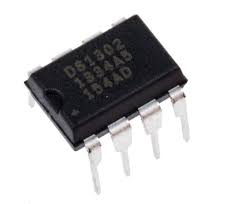
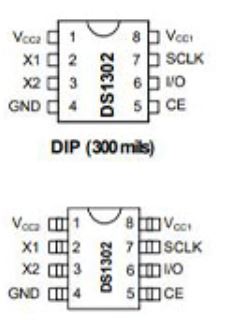
DS1302 Pin Connections Overview
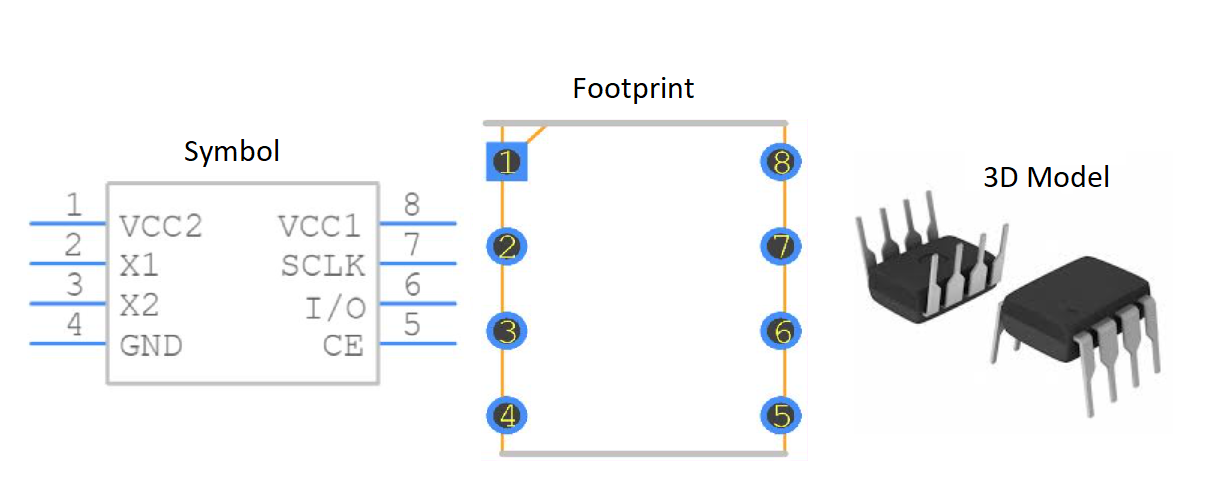
CAD Model of DS1302
Overview of DS1302
The DS1302 combines a real-time clock/calendar with 31 bytes of static RAM, crafted to suit low-power scenarios. It provides meticulous timekeeping information for seconds, minutes, hours, days, dates, months, and years, complete with leap year adjustments handled effortlessly. This system allows for both 24-hour and 12-hour time formats, featuring an AM/PM indicator to cater to user preferences of digital time display norms. Its serial communication interface eases connectivity with diverse microprocessors, embodying adaptability in system design.
Features of DS1302
Integrated Timekeeping and Data Handling
The DS1302 proves to be a well-rounded option for timekeeping tasks, encompassing all operations while providing temporary data storage within its RAM. Timekeeping is executed efficiently via a streamlined three-wire serial interface, enabling smooth communication with microcontrollers. This setup accommodates diverse data transfer methods, such as single-byte and burst mode, injecting flexibility into intricate systems.
Efficient Energy Use
A notable characteristic of the DS1302 is its prudent power usage, functioning within a voltage range from 2.0V to 5.5V. When operating at 2.0V, it uses only 300nA, presenting itself as a well-suited choice for low-power applications like battery-powered gadgets. This level of energy efficiency cuts down the frequency of battery changes, prolonging the equipment's life—a beneficial factor for managing remote setups who seek reliability and fewer interruptions.
Space-Economical Design
The DS1302's compact 8-pin DIP and SO packages ensure it takes up minimal space, an attractive trait in the design of devices where every bit of space is invaluable. The form factor's versatility is apparent in its employment across various sectors, from consumer electronics to industrial machines. Furthermore, its small package eases the incorporation of the chip into existing circuit designs, making it simpler for us to upgrade older systems without hassle.
Wide Operating Temperature Range
The DS1302's capability to function reliably within an industrial temperature range extends its applicability, allowing it to thrive under challenging environmental conditions. This trait makes it a dependable choice for devices that must perform steadily in extreme temperatures, such as those in outdoor settings and automotive applications. The robust temperature tolerance stands as a testament to its unwavering reliability, a trait that highly regard in mission scenarios.
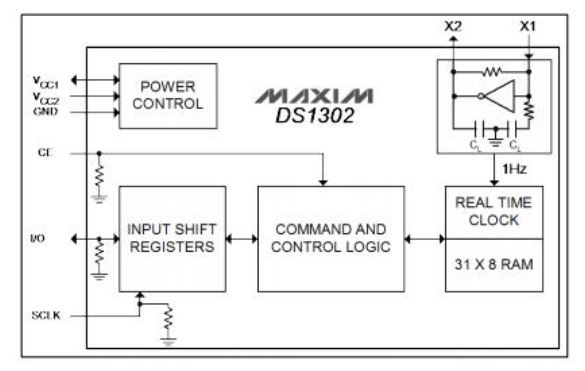
DS1302 Functional Block Diagram
Technical Specifications
Maxim Integrated provides a broad spectrum of specifications for the DS1302+, serving as a comprehensive guide to grasp its capabilities and integrate it seamlessly into diverse applications. The DS1302+ excels in precise timing functionality, an aspect for systems keen on maintaining meticulous timekeeping and efficient data management. The table below is the technical specifications, attributes, parameters of the Maxim Integrated DS1302+.
|
Type |
Parameter |
|
Factory Lead Time |
9 Weeks |
|
Mount |
Through Hole |
|
Package / Case |
8-DIP (0.300, 7.62mm) |
|
Weight |
930.001806mg |
|
Packaging |
Tube |
|
JESD-609 Code |
e3 |
|
Part Status |
Active |
|
Number of Terminations |
8 |
|
Type |
Clock/Calendar |
|
Voltage - Supply |
2V~5.5V |
|
Peak Reflow Temperature (Cel) |
260 |
|
Terminal Pitch |
2.54mm |
|
Base Part Number |
DS1302 |
|
Number of Outputs |
1 |
|
Power Supplies |
3/5V |
|
Memory Size |
31B |
|
Clock Frequency |
0.032MHz |
|
Time Format |
HH:MM:SS (12/24 hr) |
|
Current - Timekeeping (Max) |
0.3µA~1µA @ 2V~5V |
|
Interrupt Capability |
N |
|
Volatile |
YES |
|
Features |
Leap Year, NVSRAM, Trickle-Charger |
|
Length |
9.91mm |
|
REACH SVHC |
No SVHC |
|
RoHS Status |
ROHS3 Compliant |
|
Contact Plating |
Tin |
|
Mounting Type |
Through Hole |
|
Number of Pins |
8 |
|
Operating Temperature |
0°C~70°C |
|
Published |
Yes |
|
Pbfree Code |
yes |
|
Moisture Sensitivity Level (MSL) |
1 (Unlimited) |
|
ECCN Code |
EAR99 |
|
Additional Feature |
BURST MODE RAM DATA TRANSFER; TIMEKEEPING
CURRENT = 0.3µA |
|
Terminal Position |
DUAL |
|
Supply Voltage |
3.3V |
|
Time@Peak Reflow Temperature-Max (s) |
30 |
|
Pin Count |
8 |
|
Operating Supply Voltage |
3.3V |
|
Interface |
3-Wire Serial |
|
Operating Supply Current |
1.2mA |
|
Logic Function |
Clock |
|
Date Format |
YY-MM-DD-dd |
|
Time-Min |
SECONDS |
|
Supply Voltage - Supply, Battery |
2V~5.5V |
|
Information Access Method |
SERIAL, 3-WIRE |
|
Height |
4.46mm |
|
Width |
7.87mm |
|
Radiation Hardening |
No |
|
Lead Free |
Lead Free |
Operating Circuit of DS1302
The DS1302 real-time clock module connects with microprocessors through a synchronous serial communication interface, necessitating just three connections: Chip Enable (CE), Input/Output (I/O), and Serial Clock (SCLK). This streamlined wiring framework is appreciated for its simplicity and reliability, reflecting the desire for elegance in design. Data transfer to and from the clock/RAM can occur either one byte at a time or in bursts of up to 31 bytes. The design enables operation on extremely low power, retaining data and clock information on less than 1 µW. The typical operating circuit is shown below.
Alternatives for DS1302
|
Part Number |
Description |
Manufacturer |
|
DS1202N |
Real Time Clock, Volatile, 0 Timer(s),
CMOS, PDIP8 |
Dallas Semiconductor |
|
DS1202 |
Real Time Clock, Volatile, 0 Timer(s),
CMOS, PDIP8 |
Dallas Semiconductor |
|
DS1302N+ |
Real Time Clock, CMOS, PDIP8, DIP-8 |
Cypress Semiconductor |
|
DS1302N |
Real Time Clock, Volatile, 0 Timer(s),
CMOS, PDIP8, 0.300 INCH, PLASTIC, DIP-8 |
Maxim Integrated Products |
|
DS1302 |
Real Time Clock, Volatile, 0 Timer(s),
CMOS, PDIP8, 0.300 INCH, DIP-8 |
Dallas Semiconductor |
Dimensions of DS1302
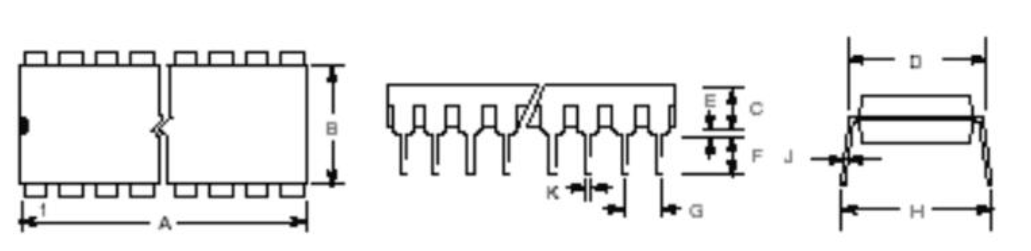
Manufacturer of DS1302
Maxim Integrated leads the technological landscape with groundbreaking advancements in synchronization, energy efficiency, and data reliability, focusing on timekeeping, power management, and communication technologies. These areas foster seamless electronic interactions and optimize energy use, ensuring dependable information exchange. The company fuels creative engineering by offering powerful tools and resources that alleviate intricate design challenges, enabling us to develop with assurance and precision.
Comparable Parts
|
|
DS1302+ |
DS1307N+ |
DS1337+ |
DS1672-2+ |
|
Manufacturer |
Maxim Integrated |
Maxim Integrated |
Maxim Integrated |
Maxim Integrated |
|
Package / Case |
8-DIP (0.300, 7.62mm) |
8-DIP (0.300, 7.62mm) |
8-DIP (0.300, 7.62mm) |
8-DIP (0.300, 7.62mm) |
|
Number of Pins |
8 |
8 |
8 |
8 |
|
Memory Size |
31B |
56B |
- |
31B |
|
Interface |
3-Wire Serial |
I2C, 2-Wire Serial |
I2C, 2-Wire Serial |
3-Wire Serial |
|
Logic Function |
Clock |
Clock |
Clock |
Clock |
|
Supply Voltage |
3.3 V |
5 V |
3.3 V |
3.3 V |
|
Number of Terminations |
8 |
8 |
8 |
8 |
|
Mount |
Through Hole |
Through Hole |
Through Hole |
Through Hole |
 FAATATAU IA TATOU
Tagata faamalieina i taimi uma.Agaalofa ma le talitonuina ma fiafia masani.
FAATATAU IA TATOU
Tagata faamalieina i taimi uma.Agaalofa ma le talitonuina ma fiafia masani.
suʻega suʻega.O oloa aupito pito sili ona maualuga tau ma le tautua sili o lo tatou tautinoga faavavau.
![[{1 1}]](/upfile/blog/small_2024110918480260951.jpg) [{1 1}]
[{1 1}]
2024-11-09
![[{1 1}]](/upfile/blog/small_2024110917355632821.jpg) [{1 1}]
[{1 1}]
2024-11-09
E masani ona fesiligia fesili [FAQ]
1. How Does the DS1302 Function?
The DS1302 chip combines a real-time clock/calendar feature with additional memory, making it capable of delivering detailed time data with ease. Its seamless integration with microprocessors empowers devices to manage time-sensitive tasks with accuracy. This capability is highly regarded in systems that require precise timing and data logging, such as those in industrial domains or various consumer electronics. By merging clock functionality with memory storage, the chip offers a comprehensive solution for synchronized operations, an emphasis on simplicity and dependability in its design.
2. Is the DS1302 Compatible with I2C?
The DS1302 is not designed as an I2C device, yet it exhibits prolonged and efficient performance, lasting up to five years, when powered by a 3V lithium battery. It uses a straightforward serial communication protocol distinct from I2C, crafted with a focus on longevity and minimal power consumption. Designing systems with this chip involves understanding its unique communication style—distinct from mainstream protocols—but offering commendable efficiency without complexity.
3. How Does the DS1302 Differ From the DS1307?
The DS1302 and DS1307 differ primarily in pin configurations and particular coding requirements, necessitating careful adaptation when switching between circuits. Grasping these differences; where interoperability among various chips is required, a precise understanding of their specific communication protocols and electrical traits is for successful integration. These subtle differences exemplify the value of adapting circuit designs to complement each component’s capabilities in crafting robust electronic systems.
4. What is an RTC?
A real-time clock (RTC) functions as a timekeeping microchip embedded within systems, sustained by a battery, ensuring a continuous supply of precise time data for computer applications. The RTC's design allows it to maintain accuracy independently of the system's main power source, enhancing effective time management across a broad range of applications. Its significance becomes clear in scenarios where temporal consistency is required, granting devices the ability to remain reliable and steady without relying on external timing solutions.
5. Why is an RTC Used?
RTCs are for precise timekeeping in various systems such as digital clocks and cameras, where exact timestamps are required. Their role is most pronounced in settings that demand strict time coordination. Efficient time management boosts system performance, supporting the achievement of goals reliant on precision, such as data collection in scientific research or timestamping in financial transactions. Ultimately, the ability to harness precision in technology frequently revolves around proper time regulation, with RTCs forming a core part of this art.
VAI VAEGA Numera
 AC0603JRNPOYBN150
 VI-26L-EY
 L6226Q
 AD9878BSTZ
 GJM0335C1E7R9DB01J
 IDT72V7230L10BBG
- GRM0336R1E6R1DD01D
 LTM2882IY-3#PBF
 GRM1557U1H8R5DZ01D
- VI-2W4-CV
- VE-2T2-CW
- 08055A271KAT4A
- CGA4C2NP01H392J060AA
- T491C156K035ZT7280
- ISL6401CBZ-T
- VI-262-IW
- GRM033R61C123KE84D
- XRA1207IG24-F
- NC7SZ00M5X
- 12065A1R2CAT2A
- ISL43141IVZ
- ATSAM3S4CA-AU
- 12063C684KAZ2A
- STTH8L06G
- C3216Y5V0J476Z/8
- 06033C153JAT2A
- LM5175PWPR
- S94810504
- AT89C51RD2-CL
- M3087LFYBGP
- M36L0R7060T2ZAQ
- MC145220FR2
- PPC405EP-3LB333C
- PW2300B-10L
- SCY99053
- UPD703273YGC-362-8EA
- UPD75518GF-233-3B9
- ADR395BUJZ
- CM6800T+XISTR
- P45278003117
- TK63133BCB-G
- UAC3556B-QI-G10
- VSPM300RQCSV100
- MM74HC595
- ATMXT640T-CCUR048
- BCM53286MIPB
- PC87366-IBM
- HYUF6404E-D551
- L-APP345E-3-2A13-DB